


Details and registration ⟶
Dragon Dance
Teacher Training
Functional anatomy, meridians, yoga philosophy and creativity in movement
200 hours
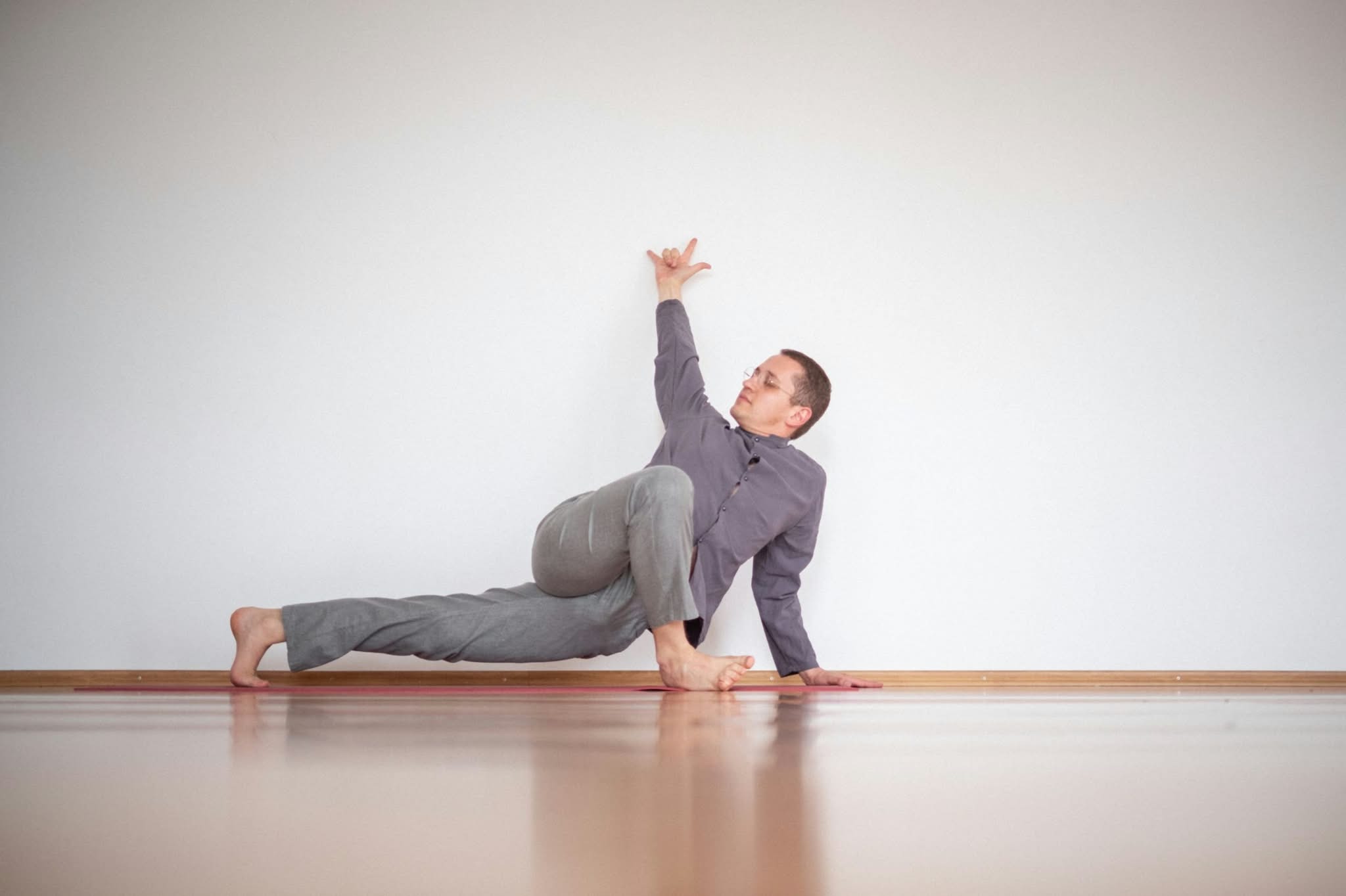
Dragon Dance Teacher Training is a comprehensive 200-hour educational programme offering a distinctive approach to dynamic yoga practice. It brings together freedom and creativity in movement with an understanding of functional anatomy, biomechanics, traditional Chinese medicine and yoga philosophy.
The programme is intended for yoga teachers and committed practitioners who wish to deepen their understanding of dynamic yoga, develop their own creativity and acquire the knowledge needed to design and teach meaningful yoga sequences independently.
Unlike approaches that focus on learning pre-designed sequences, this training encourages participants to understand the principles through which movement emerges, develops and connects into a whole.
1 / 8
Functional anatomy and the biomechanics of movement
The anatomy component of the programme centres on Paul Grilley’s functional approach to yoga, with particular emphasis on skeletal variation, individual anatomical differences and an understanding of tension and compression.
Through theoretical lectures, anatomical analysis and practical work, we study joint stability and mobility, the biomechanics of movement, different planes of movement and the ways in which body structure influences dynamic yoga postures and their transitions.
Particular attention is given to adapting sequences to different bodies, understanding each individual’s functional possibilities and distinguishing aesthetic and functional approaches to yoga.
Meridians and five-element theory
The meridian system and five-element theory of traditional Chinese medicine form a second important area of the training.
Participants explore the fundamental concepts of yin and yang, five-element theory (Wu Xing), relationships between meridians and the functional systems of the internal organs (Zang Fu), and traditional interpretations of their connections to physical and emotional experience.
Particular emphasis is placed on the practical application of a meridian-based approach in Dragon Dance. We explore how different movements, directions and sequences can be related to the traditional meridian model and how five-element theory can serve as a thematic framework for shaping dynamic yoga practice.
Yoga philosophy
Yoga philosophy also holds an important place in the programme. Through studying its historical and philosophical foundations, classical texts and different currents of yogic thought, participants deepen their understanding of the traditions from which contemporary yoga practice developed.
Particular attention is given to the practical application of philosophical teachings in everyday life and yoga practice. Philosophy is approached not merely as a collection of ancient ideas, but as a field of knowledge that encourages reflection on our actions, relationships with others, attention, responsibility and the way we live and teach.
Pranayama, breathing and meditation
Breathing is an integral part of dynamic yoga practice and also an area of study in its own right.
Through theoretical and practical work, participants explore different pranayama techniques, their traditional foundations and contemporary physiological explanations. Particular attention is given to the relationship between breathing and movement, the rhythm of practice, regulating intensity and applying breathing techniques in different parts of a yoga class.
Meditation and the development of attention also hold an important place in the training, both as aspects of personal practice and as knowledge participants can incorporate into their own teaching.
Creativity in movement and teaching methodology
One of the central areas of the programme is developing the ability to design and teach Dragon Dance sequences independently.
Participants explore relationships between individual asanas, ways of connecting them, transitions, changes in direction and planes of movement, and the role of rhythm, breathing and continuity in dynamic practice.
Particular attention is given to teaching methodology, clear communication, adapting to different levels of experience and developing the ability to observe and understand participants.
The aim is not simply to learn existing Dragon Dance sequences, but to gain the knowledge needed to create one’s own practices that are anatomically considered and coherent in their content.
What makes this approach distinctive?
Dragon Dance is not simply a series of linked yoga postures or choreography to be memorised. Its value lies in understanding the principles through which movement emerges, develops and connects into a meaningful whole.
By bringing together functional anatomy, biomechanics, traditional Chinese medicine, yoga philosophy, pranayama and teaching methodology, the training provides a broad theoretical and practical foundation for yoga teachers’ development.
The knowledge gained during the programme extends beyond Dragon Dance. It can also be applied in Vinyasa Yoga, Power Yoga and other dynamic styles, as well as in personal practice, understanding the body and everyday life.
The aim of the training is not to produce teachers who all teach in the same way, but teachers who understand what they teach and have the knowledge, confidence and creative freedom to develop their own approach to yoga.
Who is the training for?
The training is intended for yoga teachers of different styles who wish to broaden their professional knowledge, develop creativity in designing sequences and deepen their understanding of dynamic yoga practice.
The programme is also open to committed practitioners with appropriate yoga experience who wish to study its anatomical, philosophical and practical foundations more systematically.
Training structure
The programme comprises 200 hours of education, organised into themed units that combine theoretical lectures, practical work, anatomical analysis, personal practice and teaching methodology.
Alongside the programme leader, guest lecturers specialising in pranayama, yoga therapy and Vinyasa Yoga contribute to particular areas of study.